Orphan Drugs
Orphan medicines, often called orphan drugs, are developed to diagnose, prevent or treat serious rare diseases. EU policy supports their development through regulatory incentives, while requiring evidence of quality, safety and efficacy.
For people living with thalassaemia, sickle cell disease and other rare anaemias, these policies influence both treatment innovation and access to care.
What qualifies as an orphan medicine
Under Regulation (EC) No 141/2000, a medicine can qualify for orphan designation if it is intended for a life-threatening or chronically debilitating condition affecting no more than 5 in 10,000 people in the EU. Prevalence is assessed across the EU, even when a condition is more common in a particular country or region.
The legislation also provides an alternative route for medicines for certain serious conditions where, without incentives, expected sales would not justify the investment needed for development.
In either case, there must be no satisfactory method of diagnosis, prevention or treatment authorised in the EU, or the medicine must offer significant benefit to those affected. Significant benefit means a clinically relevant advantage or a major contribution to patient care, as defined in Commission Regulation (EC) No 847/2000.
From designation to patient access
Orphan designation, marketing authorisation and access to treatment are separate steps.
| Step | Who is involved | What it means |
| Orphan designation | EMA’s Committee for Orphan Medicinal Products gives an opinion; the European Commission grants designation. | Recognises that the designation criteria are met and supports development through incentives. |
| EU marketing authorisation | EMA’s Committee for Medicinal Products for Human Use assesses the medicine; the European Commission decides. | Allows the medicine to be marketed for its approved use. |
| Access to treatment | National authorities, healthcare services and the treating team, alongside the company’s launch and supply decisions. | Depends on funding, availability, suitable services and the patient’s eligibility. |
Orphan designation can be granted during development and does not establish that a medicine is safe or effective. Before approval, EMA assesses its quality, safety and efficacy; orphan status does not remove these requirements. Some medicines receive conditional authorisation, which requires the company to provide further evidence after approval. Safety monitoring continues throughout a medicine’s use.
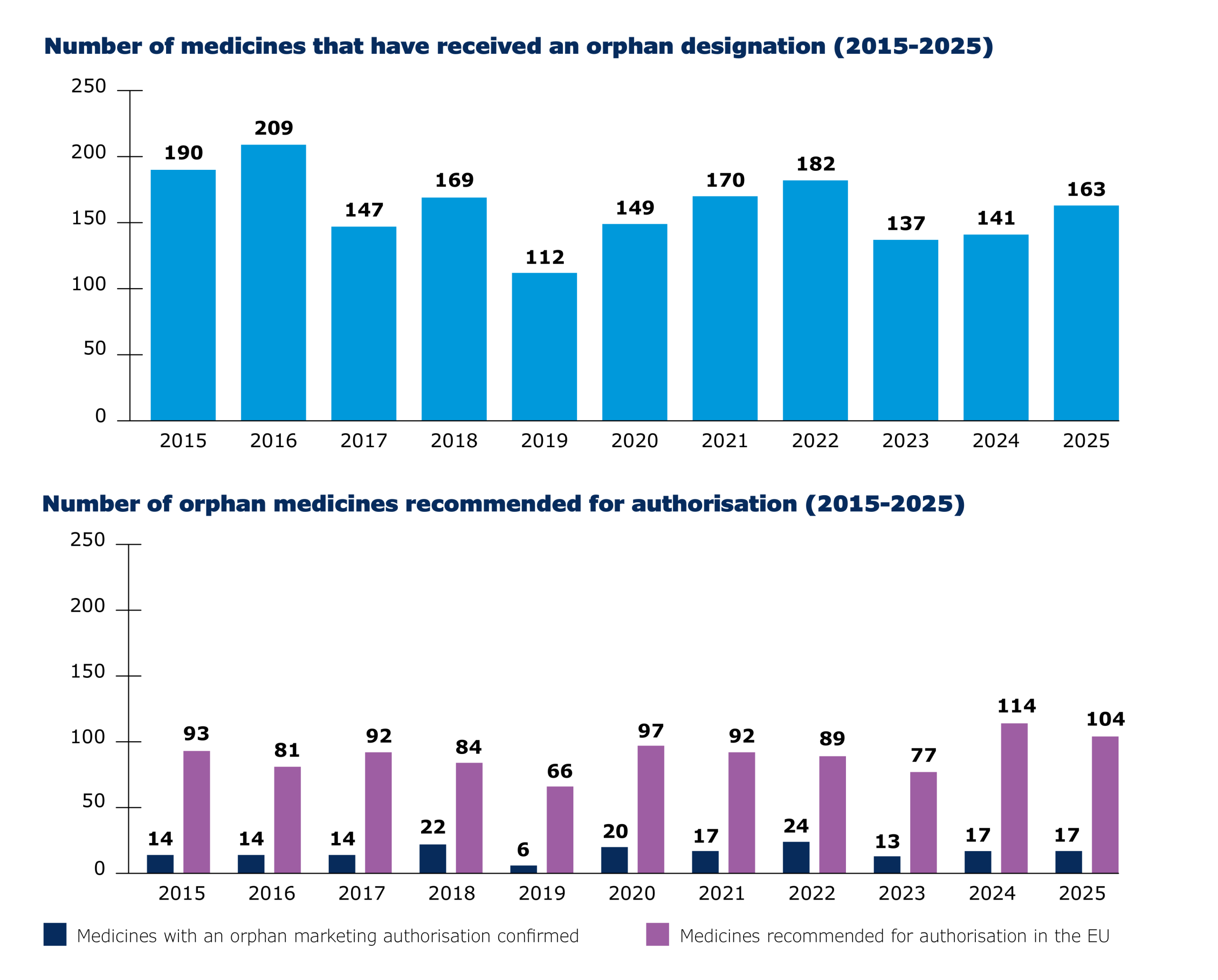
Incentives under the current EU framework
The EU offers scientific and regulatory support, including protocol assistance, a form of scientific advice tailored to orphan medicines.
Fee reductions depend on the applicant and the procedure; additional support is available for eligible small and medium-sized enterprises.
Medicines that retain orphan status at authorisation generally receive 10 years of market exclusivity for the relevant indication. This limits the authorisation of similar medicines for the same indication, subject to legal exceptions.
A two-year extension may be available when the agreed paediatric investigation plan and the other legal requirements are fulfilled. Orphan exclusivity is distinct from patent protection.
The 2026 pharmaceutical reform
Following the political agreement of December 2025, the Council adopted its position on the EU pharmaceutical package on 28 September 2026. As of this page’s review date, adoption by the European Parliament and publication in the Official Journal are still pending. The new orphan medicine rules are therefore forthcoming, rather than already applicable. See the Council’s latest update.
The Council text provides for:
- Nine years of market exclusivity for most orphan medicines.
- Eleven years for qualifying breakthrough orphan medicines: no medicine is authorised in the EU for the condition, and the new medicine produces a clinically relevant reduction in illness or mortality.
- Four years for orphan medicines authorised based on well-established medical use, with limited extensions available for other eligible orphan medicines gaining additional indications for different orphan conditions.
The wider package also strengthens tools to address medicine availability and shortages. EMA currently anticipates application of the new framework in 2028, following a transition period. The final legislation and its transitional provisions will determine when each change applies, including how existing products are treated.
EU clinical assessment and national access decisions
 The EU Health Technology Assessment Regulation has applied since 12 January 2025. It introduces joint clinical assessments of how a medicine compares with existing options, supporting national decisions and reducing duplicated assessment work.
The rollout covers new cancer medicines with new active substances and advanced therapy medicinal products from 2025; orphan medicines join from 13 January 2028, unless already covered by the earlier phase. Other medicines within the Regulation’s scope follow from 13 January 2030. Patients and clinical experts contribute to these assessments.
Joint assessment does not set a medicine’s price or guarantee reimbursement. National authorities retain responsibility for funding decisions. Access also depends on commercial launch, reliable supply, individual eligibility and the health system’s capacity to deliver treatment. These factors can lead to differences between countries after EU approval.
Why this matters for haemoglobin disorders
In the European Union, thalassaemia and sickle cell disease remain rare in many Member States, despite substantial growth in patient populations in several countries in recent years. EU orphan medicine policy provides scientific advice and development incentives to support treatments that improve care and reduce treatment burden. For orphan designation, the EU assesses rarity across the EU as a whole.
Examples of orphan-designated medicines include deferasirox (Exjade) for iron overload, luspatercept (Reblozyl) for anaemia in adults with beta-thalassaemia, and Casgevy for selected patients with transfusion-dependent beta-thalassaemia or severe sickle cell disease.
Approval must be followed by sustainable access. Zynteglo’s EU authorisation was withdrawn for commercial reasons in 2022, illustrating why innovation needs to be accompanied by effective reimbursement, reliable supply and specialist care.
Priorities for equitable access
Effective orphan medicine policy should:
- Encourage treatments that address unmet needs and deliver benefits that matter to patients, including quality of life and reduced treatment burden.
- Support timely, affordable access across countries through transparent assessment and sustainable funding arrangements.
- Ensure that specialist services, reliable medicine supplies and established treatments remain available alongside new therapies.
- Involve patients in research priorities, trial design, regulatory assessment and health technology assessment.
- Generate long-term evidence through appropriate follow-up and registries, with safeguards for personal data.
TIF’s position papers provide further perspectives on access to advanced therapies and care for people with haemoglobin disorders.
Useful links:
EU orphan medicines legislation — Read Regulation (EC) No 141/2000 and its designation and incentive framework. Implementing definitions are in Regulation (EC) No 847/2000.
EMA orphan designation overview — Understand orphan designation, regulatory responsibilities and development incentives.
EU pharmaceutical reform — Follow the reform, legislative documents and implementation updates.
EU health technology assessment — Find joint assessment information and opportunities for patient involvement.
EMA medicine search — Check approved uses, patient leaflets, assessment reports and safety updates.
European Commission Union and Orphan Registers — Verify authorisation decisions and orphan designations in separate active and withdrawn or expired lists.
Clinical Trials Information System — Search EU and EEA clinical trials and their public information.
ERN EuroBloodNet — Explore specialist expertise and resources for rare haematological diseases.
TIF clinical trial updates — Follow research developments in thalassaemia and sickle cell disease.
TIF position papers — Read TIF’s positions on advanced therapies and access to care.