Clinical Trials
A clinical trial is a research study conducted in human beings with the goal of answering specific questions about new therapies, vaccines or diagnostic procedures, or new ways of using known treatments.
Clinical trials evaluate how well an intervention works and examine its potential benefits, risks and side effects. When well designed and carefully conducted, they generate reliable evidence to guide healthcare decisions and improve patient care.
Clinical trials of medicines in the European Union (EU) and European Economic Area (EEA) are governed by Regulation (EU) No 536/2014, known as the Clinical Trials Regulation.
The Regulation became applicable on 31 January 2022, replacing Directive 2001/20/EC. Its transition period ended on 31 January 2025. Ongoing trials within its scope must now follow the Regulation and be managed through the Clinical Trials Information System (CTIS).
National authorities and ethics committees assess clinical trials. CTIS supports coordinated applications, assessment and oversight across participating countries, and provides public access to trial information while protecting personal data.
Learn more about the EU Clinical Trials Regulation
What Are the Different Phases of a Clinical Trial?
Before a potential new medicine is tested in people, laboratory and other non-clinical research provides information to support the proposed human studies.
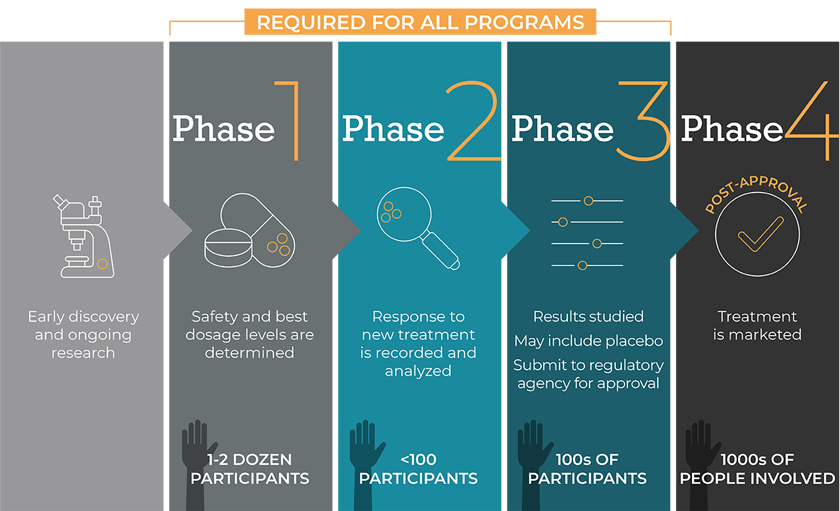
Clinical development is commonly described through the following phases:
- Phase I — initial safety and dose: Researchers investigate tolerability, side effects, how the medicine behaves in the body, and appropriate doses. Participants may be healthy volunteers or people with the condition being studied.
- Phase II — initial evidence of benefit: Researchers study the medicine in people with the condition, explore its effects and dose, and continue evaluating safety.
- Phase III — confirmatory evidence: Researchers gather more extensive evidence about benefits and risks, often comparing the medicine with an appropriate control, such as standard treatment or placebo.
- Phase IV — research after authorisation: Further studies examine safety, effectiveness or additional aspects of use once a medicine has been authorised. Routine monitoring of side effects also continues.
These phases are a general overview. They can overlap or be combined, and study size and duration depend on the condition, treatment and research question.
Trial results contribute to the evidence regulators review when assessing a medicine’s quality, safety, effectiveness and balance of benefits and risks. Completing a trial does not automatically lead to authorisation.
For medicines assessed through the EU centralised procedure, the European Medicines Agency (EMA) provides the scientific evaluation and the European Commission makes the legally binding authorisation decision.
An Authorised Medicine’s Journey:

The European Medicines Agency (EMA)’s booklet ”From laboratory to patient: the journey of a centrally authorised medicine” is a useful and comprehensive resource that describes the journey of a medicine for human use authorised through EMA, from initial research to discussions on patient access to medicines across the EU.
In particular, this useful informative guide describes how EMA supports medicine development by providing scientific advice and how it assesses a medicine’s benefits and risks once it receives an application for marketing authorisation, including details on scientific advice, medicines’ evaluation and discussion at national level on access and pricing.
WHO Best Practices Guidance for Clinical Trials
 In September 2024, the World Health Organization (WHO) released groundbreaking guidelines to strengthen the design, conduct, and oversight of Clinical Trials globally.
This initiative aims to bolster country-led research and development (R&D) ecosystems, making innovative, safe, and effective health interventions more accessible and affordable for everyone, faster than ever before.
The Guidance addresses key challenges such as poor trial design, limited participant diversity, inadequate infrastructure, and bureaucratic inefficiencies.
Why Participate in a Clinical Trial?
People may join a clinical trial to contribute to research or explore an investigational treatment. However, personal benefit is not guaranteed. An investigational treatment may be ineffective, cause side effects, or involve risks that are not yet fully understood. Eligibility depends on the study’s requirements.

Before deciding, discuss the trial with your treating clinician and the research team. Useful questions include:
- What is the study investigating, and which treatment could I receive?
- What are the possible benefits, risks, and alternatives?
- What visits, tests, and follow-up will be required?
- How will participation affect my usual treatment?
- What expenses are covered, and what arrangements apply if I experience a research-related injury?
- What happens when the trial ends or if I withdraw?
The informed-consent process should explain the study clearly and give you time to ask questions. Participation is voluntary: you may decline or withdraw without losing the care or benefits to which you are otherwise entitled. The team should also explain how your personal information will be protected.
Also See:
All new therapies/drugs that enter clinical trials are listed in specialized portals, where one can find all relevant information.
https://clinicaltrials.gov/ https://www.clinicaltrialsregister.eu/